Lawn care, mowing & fertilization across Central Ohio

☎ 202 555 0123

Home

/

Services

/

Fertilization

Fertilization

Lush Lawns Start With Fertilization In Central Ohio

Your grass is weak and yellow after mowing and watering.

Smiggs Lawn Care feeds your lawn regularly to help it thicken and turn green.

Free

No-obligation estimates

10

Central Ohio communities

1 day

Typical reply time

Get your free estimate

We reply within one business day.

Thanks, we've got it. We'll call you within one business day with your estimate.

Or call 202 555 0123

✓

Free estimates

Tell us about your lawn and we'll send a clear price before any work starts. No obligation.

✓

Local Ohio crew

We serve Delaware, Dublin, Powell, Columbus and nearby Central Ohio towns.

✓

On schedule, all season

Visits are planned around the growing season, so your lawn gets the right care at the right time.
Why it matters

A lawn slowly starving

Yellow grass is often a sign the soil has little left to give. Without enough nutrients, blades can't build the deep roots that help them withstand stress. Each mowing takes a little more out of ground that can't replenish itself.Our six-step program feeds your lawn on a schedule that matches Central Ohio's growing seasons. The granular fertilizer releases slowly, so nutrients are available for weeks without burning. We also use pet-friendly products for our applications.

Where we offer it

Fertilization in your town

Available in 10 Central Ohio towns. Tap your town to see local details and get a quote.

Don't see your town? See all our service areas or ask us and we'll confirm.

Fertilization

How it works

Get free quote

1

2

3

4

5

Pricing guide

Lawn Fertilization Application Prices

The table shows typical price ranges for lawn fertilization. Each row represents a different lawn size. The price shown is for a single application of granular fertilizer. A full program includes six applications throughout the growing season.

Lawn SizeFertilization PriceUnit
Under 5,000 sq ft$45 to $70per application
Quarter-acre lawn$70 to $85per application
5,000–10,000 sq ft$85 to $105per application
10,000–20,000 sq ft$105 to $139per application

These prices are estimates for planning purposes. The final cost for any job depends on the specific size and condition of the lawn. An exact quote is provided for every project before work begins.

Grass That Comes Back Thicker

Each visit puts down a granular feed that breaks down over time, so the grass keeps drawing on it long after the spreader passes. Roots get something to work with again, and the blades stop running on empty.

The result is a lawn that holds its color from one week to the next and thins out less when the weather turns dry. Fertilization is what keeps that progress from slipping away between visits.

What You Notice Afterward

A Marysville lawn fed on a steady rhythm holds up through the season instead of stalling out. Skip that rhythm and the grass runs down to pale and thin by midsummer.

Once the applications are underway, the change shows across the whole yard rather than in one good week. The lawn looks even and full, and it holds that look through the summer.

Spreader Setup and Timing

Work starts with a lawn inspection and, when available, a soil test, so applications match soil needs. The spreader is calibrated to the product label and the measured lawn area, so the rate is controlled rather than estimated. A measuring device or area estimate sets the quantity and the setting.

The usual tool is a walk-behind rotary or broadcast spreader, with a drop spreader as an option where precise edge control is needed. Six treatments are spread across the growing season, which usually runs about 191 days between the last spring freeze and the first fall freeze.

Scheduling follows the freeze pattern, with the last spring freeze usually around April 18 and the first fall freeze around October 27. Frozen or snow-covered ground is avoided, since fertilizer cannot be worked into actively growing turf, and heavy rain, saturated soil and standing water are unsuitable because water can move granules off the property.

Nutrients in Soil Water

Granular fertilizer supplies mineral nutrients that dissolve in soil water and become available for uptake by turfgrass roots. Roots absorb nutrients from the soil solution, and soil texture, organic matter, acidity, drainage and moisture all affect how those nutrients are retained and transported.

Precipitation falls in every month, from about 2.4 inches in February to about 4.7 inches in July, so soil moisture can alternately help nutrient movement and raise the risk of loss. Adequate potassium supports the plant’s regulation of water and dissolved substances and its tolerance of environmental stress.

Repeated moderate nutrient inputs can maintain turf density, letting the canopy cover soil more completely. Skipping fertilization can leave turf unable to replace nutrients removed by growth, with lower vigor, density and color when soil supplies fall short. Uneven distribution can show as alternating dark and pale bands, and concentrated granules can injure leaf tissue through localized salt effects.

Six Feeds Along the Drive

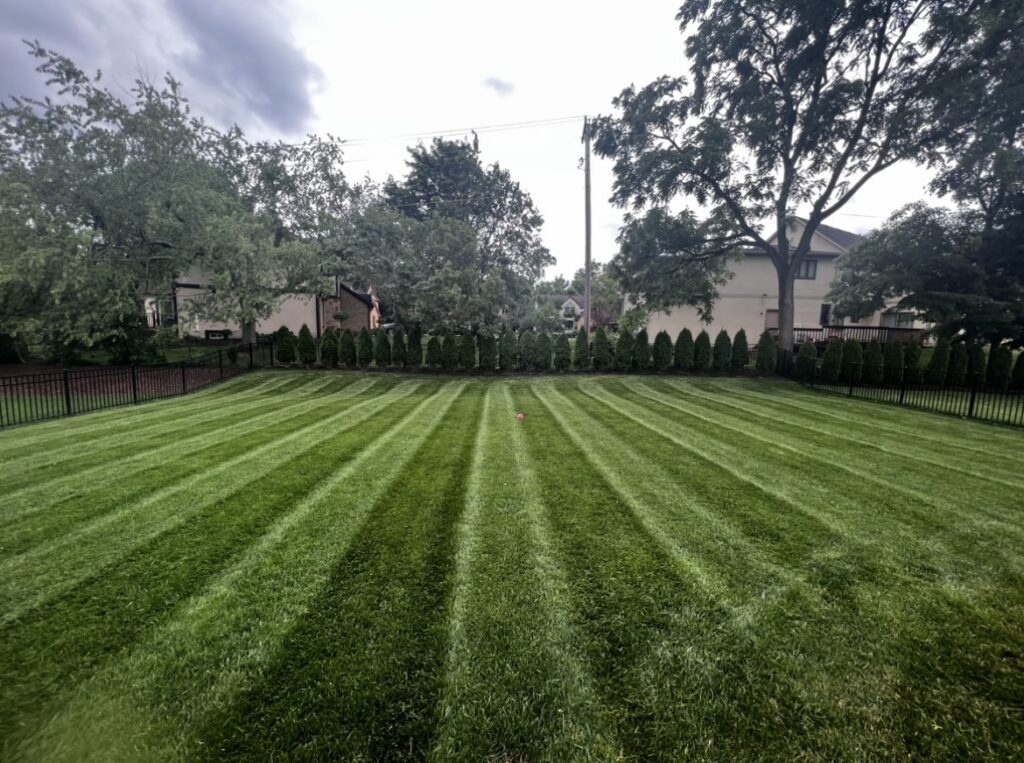
Consider a lawn along a long driveway where the grass has gone pale and thin. A granular fertilizer goes down six times over the growing season, and each application is pet-friendly. The feed nourishes the turf, so the lawn looks fuller and greener along the drive.

SMIGGS Lawn Care

Let's talk about your lawn

Questions about the service or your yard? Get in touch.

☎

202 555 0123

Call us

@

test@testmail.com

Email us

◎

Delaware, Dublin, Powell & Central Ohio

Service area

◷

Mon - Sat: 6AM - 6PM

Working hours

Send us a message

We'll respond within one business day.

Message sent. Thanks, we'll be in touch within one business day.

Common Questions About Fertilization

What does fertilization do for a lawn that looks weak and yellow?

We feed your lawn on a regular schedule so the grass thickens and turns green. When the grass looks pale and weak after you mow and water, that steady feeding is how we turn it around.

How often do you fertilize a lawn during the growing season?

The program covers six applications spread over the growing season. Because the granular feed breaks down slowly, nutrients remain in the soil for weeks without burning the turf. The products we apply are pet-friendly.

How much does fertilization cost for a quarter-acre lawn?

A quarter-acre lawn runs $70 to $85 for a single application. The price depends on lawn size, from $45 to $70 for lawns under 5,000 sq ft and $105 to $139 for 10,000 to 20,000 sq ft. A full program means six applications during the season.

What will I notice in my lawn after the applications start?

After the first few visits, the improvement shows over the entire yard, not just in one good week. Your lawn ends up looking full and even, and that holds through the summer. Without a steady rhythm, grass tends to run pale and thin by midsummer.

How do you set up the spreader and schedule the treatments?

Each round starts with a lawn check and a soil test when one is available. We set the spreader to the label rate for the measured area, usually a walk-behind rotary or broadcast model. Six treatments are spaced through the growing season, and we skip frozen ground, heavy rain and saturated soil.
Secret Link